
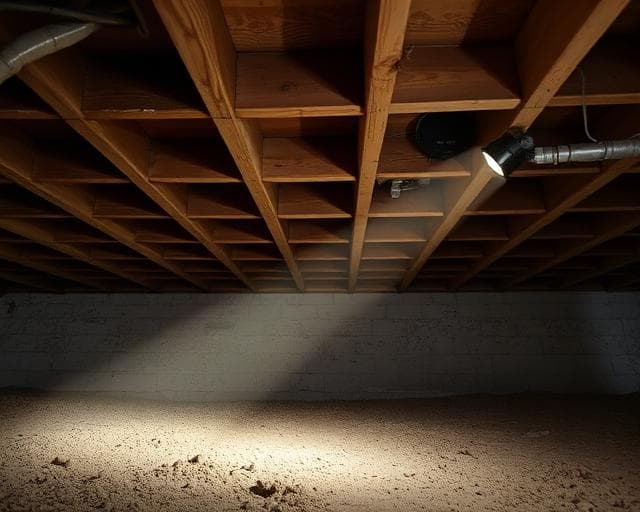
Mold Remediation in Garner, NC
Built for the crawl spaces and partial basements under Garner’s older homes
Contained, HEPA-filtered remediation that removes what is spent, treats the structure, and finishes by sealing the space so it stops re-wetting itself. Clearance tested and backed by a five-year warranty.
What Decades-Old Crawl Spaces Look Like Underneath
A great deal of Garner is made up of ranch and split-level homes built when a crawl space was expected to breathe rather than stay sealed. Those houses were well made, and most of them have decades left in them, but the assumptions underneath them have not aged well. This is what we typically find:
Split-Levels and Partial Basements
Split-levels are common here and they behave differently from a house sitting entirely above a crawl space. Part of the living area is below grade, with finished walls against soil, which means moisture arrives through the assembly rather than up through an open void you can walk into and inspect.
Panelling and finished walls in a lower level hide the early warning signs, so the first thing many owners notice is a smell in one room or carpet that never quite dries after a wet week. The remediation question then becomes whether the fix is interior drainage, exterior grading, or both, and that is worth answering before anything is opened up.
Houses That Have Been Added To
Sixty-year-old homes rarely reach the present in their original shape. Sunrooms, bumped-out kitchens, converted carports and enclosed porches all create a junction where two roofs, two foundations and two eras of construction meet, and those junctions are where we find leaks more often than anywhere else.
Crawl space levels frequently change at the same line, so an addition may sit lower, drain differently, or have been built over ground that was never covered. When the damage sits near one of these transitions, we scope the whole junction rather than the square metre with the stain on it.
The Order We Work In
Find the water first
Moisture readings and a look at the exterior before any material is removed. In a house this age there is usually more than one source, and fixing the obvious one while missing the second is how people end up paying twice.
Contain and filter
Where the work reaches finished rooms, the area is sealed and put under negative pressure with HEPA-filtered air scrubbers. Crawl space work is naturally separated, but the access point still gets managed.
Strip out what is spent
Saturated insulation, degraded vapour barrier and any porous material that has been colonised comes out. That also gives us clear sight of the joists, sill and subfloor.
Treat the structure
Framing and other non-porous surfaces are cleaned and treated in place. This is the point where any structural softening in joists or subfloor gets identified and flagged rather than covered back up.
Dry to a reading
Controlled drying with dehumidification until the material reaches target moisture content. We work to the meter, not to a fixed number of days.
Close the space properly
A sealed and lapped vapour barrier, vents addressed, drainage and downspouts corrected, and dedicated dehumidification where the space warrants it. This is the part that decides whether you see us again.
Clearance Testing and Warranty
We finish with a measurement rather than an assurance. Post-remediation samples are analysed by an independent laboratory and compared against outdoor controls, and you receive documentation showing the work achieved what it set out to do. The remediation carries a five-year warranty.
In an older home that paperwork tends to earn its keep later. If the house is sold, a clearance report answers the crawl space question a buyer’s inspector is going to raise, and answers it with lab results instead of reassurance.
Sealing the crawl space for good
Where remediation keeps returning, the durable answer is usually to close the space entirely. See crawl space encapsulation in Garner, NC, or start with mold inspection and testing if you are not yet sure what you are dealing with.
See encapsulationWhere we work around Garner
Free estimates across southern Wake County and the surrounding area:
Frequently Asked Questions
Common, but not normal, and not something to live with. Crawl spaces of that era were built to be vented rather than sealed, and many never had a vapour barrier at all. A persistent earthy or musty smell is the space telling you it is holding moisture, and because that air moves upward into the living space, it does not stay a crawl space problem.
It usually does. Split-levels put finished living space partly below grade, so you are dealing with wall assemblies against soil rather than an open crawl space you can work in. That affects how we contain the area, how we dry it, and whether the fix is interior drainage, exterior grading or both. We scope it on site rather than assuming.
Additions are where two roofs, two foundations and two eras of construction meet, and those junctions are the most common leak points we find in older Garner homes. Flashing details age, the original exterior wall becomes an interior one, and any water getting in has somewhere concealed to sit. It is worth checking the whole transition rather than just the visible damage.
If it is wet or has mold growing on it, yes. Fibreglass batting holds water and loses its usefulness once it is saturated, and it tends to sag away from the subfloor long before anyone notices. Removing it also lets us see and treat the joists and subfloor properly, which is where the structural concern actually lies.
A dehumidifier in an open, vented crawl space is fighting the outdoors and will lose, while running continuously. It becomes effective once the space is sealed: ground covered, vents closed, the envelope tightened. Sequence matters, and doing it in the wrong order is why some homeowners conclude dehumidification does not work.
Most crawl space work happens entirely outside your living space, so day-to-day life carries on. Where remediation reaches into finished rooms we seal the area and run negative air pressure through HEPA filtration so the rest of the house stays separated. We will tell you which rooms are affected and for how long before we begin.
Get a Free Estimate
Tell us what you are dealing with and we will scope the remediation.
Ready to help?
Speak with our team today and schedule a specialist for your Garner property.
Call Us Today