
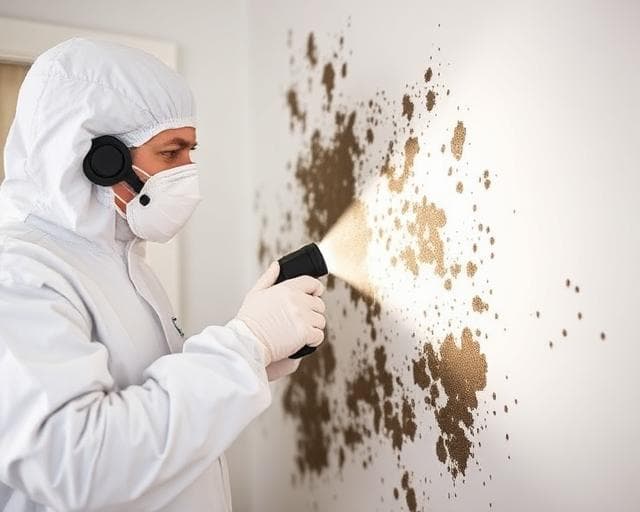
Mold Inspection & Testing in Apex, NC
We trace where the water is getting in, not just where the mold ended up
Moisture mapping, thermal imaging and air and surface samples read by an accredited independent laboratory. You get readings on the day and a written report you can take to a builder, an insurer or a buyer.
What Clay Soil Does to an Apex Crawl Space
Apex sits on the heavy red clay that runs through the Piedmont, and clay does not drain. Water that would soak away within hours on sandier ground instead sits where it lands, which on most properties means against the foundation and under the house. A downspout discharging a foot from the wall is enough to keep a crawl space damp through an entire season.
This is why an inspection here is as much about the outside of the building as the inside. We walk the perimeter, look at where the ground falls, follow the gutters and check where the downspouts actually end, because in this soil that chain usually explains the moisture readings we take underneath.
Mold is the visible part. On clay, the story almost always starts with where the rainwater went.
A New Subdivision and an Older Downtown Home Fail Differently
Subdivision homes, 1995 onward
Tight building envelopes, generously sized air conditioning and builder-grade crawl spaces. The failure mode is rarely a dramatic leak. It is humidity that never leaves: a system that cools the air fast without running long enough to dry it, condensation on cold supply ducts, and a vapour barrier that was laid rather than sealed.
Older homes around the Salem Street core
Decades of settling, additions built at different times, and drainage that was adequate before the surrounding lots were developed. Here the problems are more familiar: water tracking in at a failed flashing detail, a crawl space with no barrier at all, or grading that has quietly reversed over thirty years.
What We Sample and Measure
Making Sense of Your Lab Report
A spore count on its own means very little. Mold is present in outdoor air everywhere in North Carolina, so the number that matters is the comparison: how your indoor sample reads against the outdoor control taken at your property on the same day, and whether the species found indoors are the ones drifting in from outside or something that is growing in the building.
We go through the report with you rather than emailing a table of figures. If remediation is warranted you get a scope of work describing what needs to come out and what needs to be corrected. If it is not, we will say so, and tell you what to keep an eye on instead.
New Construction and Builder Warranties
A great deal of Apex housing is recent enough to still be inside some form of builder warranty, and drainage, grading and crawl space ventilation defects are precisely the kind of thing those warranties are meant to cover. The difficulty is that damp is easy to dismiss as a maintenance issue unless you can show numbers.
A dated inspection report with moisture readings, photographs and lab results turns a conversation about a smell into a documented defect. If you are approaching the end of a warranty period and something under the house has never felt right, that is a sensible moment to have it looked at properly.
Already found mold?
If the growth is visible and you know where the water came from, testing first is often a step you can skip. Go straight to mold remediation in Apex, NC and we will scope the work instead.
See mold remediationAreas we inspect around Apex
Free estimates across western Wake County and the surrounding area:
Frequently Asked Questions
Yes, and newer Apex homes are not the exception we wish they were. Tight, well-sealed envelopes hold moisture in rather than letting it dry out, air conditioning that is generously sized cools the air quickly without running long enough to remove humidity, and a builder-grade crawl space over clay can stay damp from the day it is closed up. New construction changes the cause, not the outcome.
A visual survey of the living space, attic and crawl space, moisture meter readings on anything suspect, thermal imaging where a wall reads cold or damp, and air samples with an outdoor control taken the same day. Where there is visible growth we take a direct surface sample so the lab can confirm what it is.
The on-site inspection of an average Apex home takes a couple of hours depending on the size of the property and how accessible the crawl space is. Laboratory analysis adds a few business days. We give you the moisture findings on the day and follow up with the written report once the samples are back.
It is a sensible thing to check. Many structural and envelope warranties on new construction run for a limited period, and grading, drainage and crawl space ventilation defects are exactly the sort of thing that surfaces inside that window. A dated report with moisture readings gives you something concrete to raise rather than a general complaint about damp.
That is most of the value. Finding growth is easy; establishing whether it is fed by surface water sitting against the foundation, a crawl space that never dries, a supply line, or condensation on cold ductwork is what determines the scope of the repair. We trace the source rather than just reporting the symptom.
It is not required, but it is increasingly common. Buyers in this market are thorough, and a pre-listing report lets you deal with anything found on your own schedule instead of during a negotiation. If the crawl space has any history of moisture, knowing the position before an offer is on the table is usually worth the cost.
Book an Inspection
Tell us what you are noticing and we will schedule a certified inspector.
Ready to help?
Speak with our team today and schedule an inspector for your Apex property.
Call Us Today