
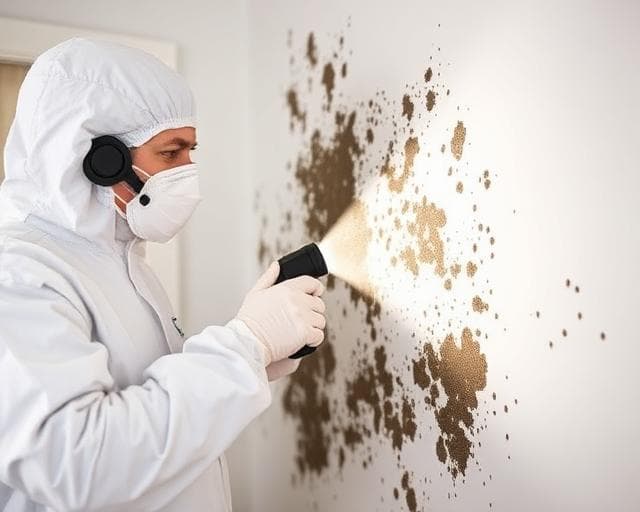
You Asked for a Test, You Probably Need an Inspection, Mold Inspection in Wake Forest, NC
Most people call wanting a number from a lab. A Wake Forest mold inspection answers a different question, which is usually the one that matters. A sample tells you what is in the air, while an inspection tells you where it is coming from. Glover Environmental runs both, and we will say which one your house actually needs.
Why Newer Wake Forest Homes Still Get Inspected
Wake Forest has grown faster than almost anywhere else in Wake County, and the housing reflects that. The historic district around downtown holds the oldest stock, close to the original college campus. Everything else has arrived in waves since.
Heritage was developed across several decades, so one neighbourhood can hold three different construction eras. Traditions and Holding Village are newer still, with Holding Village built around a lake and park near downtown. A house there might be ten years old.
That age profile changes what an inspection is looking for. Owners of newer homes often assume mold is an old-house problem, so nobody looks until there is a smell. In practice a tight modern envelope holds construction moisture and everyday humidity in. A single uncommissioned bath fan can sustain growth behind a wall for years.
Older homes in the historic district have the opposite profile. They leak air, dry out more readily, and show their problems earlier, usually at a crawl space or a roof detail.
Climate applies to both. The regional long-term station records a 43.34 inch annual rainfall normal at a 60.8 degree mean temperature. The EPA puts the indoor ceiling at 60 percent relative humidity, with 30 to 50 percent as the ideal band.
What a Lab Result Can and Cannot Tell You
This is the part most homeowners are never told, and it comes straight from the EPA.
There are no federal limits for mold or mold spores. The EPA states plainly that because no such limits exist, sampling cannot be used to check a building against a federal standard.¹ No lab can tell you your Wake Forest house passed.
Sampling is also often unnecessary. Where mold growth is already visible, the EPA's position is that sampling usually adds nothing.² The useful question becomes where the moisture is coming from.
Where sampling does earn its place is verification. The EPA notes surface sampling is useful to determine whether an area has been adequately cleaned or remediated.² It also says sampling should be designed and interpreted by people with specific experience, with analysis following AIHA or ACGIH methods.³
The condition behind all of it is humidity. The EPA ceiling is 60 percent relative humidity, ideally 30 to 50, against a local 43.34 inch annual rainfall normal.⁴
- 1U.S. EPA, A Brief Guide to Mold, Moisture, and Your Home: federal limits for mold or mold spores
- 2U.S. EPA, A Brief Guide to Mold, Moisture, and Your Home: when sampling is and is not useful
- 3U.S. EPA, A Brief Guide to Mold, Moisture, and Your Home: who should design and interpret sampling
- 4NOAA NCEI U.S. Climate Normals and U.S. EPA, Annual climate normals near Wake Forest; EPA indoor humidity guidance
Not Sure Whether You Need Testing or Looking?
It is a fair question, and the answer changes the cost. If you can see growth, an inspection that finds the moisture source is usually worth more than a lab result. If you cannot see anything but the house smells, sampling may be the way to locate it. Glover Environmental works that out with you before anything is booked.
What a Wake Forest Inspection Covers
An inspection is a search for a moisture path, not a tour with a torch. Each stage below narrows where the water is coming from, and sampling only enters if the search justifies it.
We Start With the Building's Age and Envelope
A 2015 Holding Village house and an 1890s home near the historic district fail in opposite ways. The newer one traps moisture inside a tight envelope, while the older one lets it in through a detail that has worn. Knowing which you have decides where we look first.
We Trace Every Mechanical Moisture Source
Bath fans, dryer runs, and HVAC condensate lines are checked for where they actually terminate. In newer Wake Forest construction an uncommissioned fan venting into a soffit or an attic is one of the most common findings.
We Meter Rather Than Guess
Wood moisture and relative humidity are read at the crawl space and any wall cavity in question. The room that prompted the call is read too. Readings get recorded by location so they can be compared later, and compared against the EPA's 60 percent ceiling.
We Decide Whether Sampling Would Actually Add Anything
If growth is visible and the source is found, the EPA's own guidance says a sample usually adds little. We will tell you that rather than bill for it. Where sampling is warranted, we say what question it is meant to answer first.
We Report the Source, Not Just the Finding
The report gives the moisture path, the readings behind it, and what would stop it. That is the part a lab result cannot provide, and the part that decides what the repair costs.
When a Wake Forest Home Is Worth Inspecting
These are the situations that bring us out here most. Several of them involve houses people assume are too new to have a problem.
The House Is Under Fifteen Years Old and Smells Musty
New construction is not exempt, and owners usually wait longer before investigating. A tight envelope holds moisture in, so a small ongoing source has somewhere to accumulate.
A Bath Fan Runs but You Cannot Find Its Vent Outside
If no exterior cap matches a running fan, it is discharging into the structure. In Wake Forest's newer subdivisions this is one of the most frequent findings and one of the cheapest fixes.
You Are Buying and the Inspector Flagged Moisture
A general home inspection flags a reading; it does not trace a source. Buying into Heritage or Traditions on a flagged crawl space is the standard reason people call us before closing.
Someone in the House Reacts and Nothing Is Visible
Where nothing can be seen, sampling has a genuine role in locating a problem. That is one of the few cases where testing leads and the inspection follows.
A Previous Remediation Was Never Verified
The EPA notes surface sampling is useful to confirm an area was adequately cleaned. If work was done and nobody checked it afterwards, that verification is still outstanding.
Why Wake Forest Homeowners Call Us
Plenty of companies will sell you a test. These are the reasons people here ask us to look first.
We Will Tell You When Sampling Is Not Worth It
EPA guidance says sampling usually adds little where growth is already visible. We would rather find the moisture path and skip a sample than bill for a number that changes nothing.
We Know How Newer Wake Forest Construction Fails
Heritage, Traditions, and Holding Village houses fail at mechanical details rather than at worn building fabric. We check fan terminations, condensate lines, and envelope sealing before assuming a structural cause.
Sampling Is Framed Around a Question
The EPA says sampling should be designed and interpreted by people with the relevant experience. We state what a sample is meant to establish before taking it, so the result can be acted on.
Findings Are Recorded So They Can Be Re-Tested
Readings go in by location and are set against the EPA's 60 percent ceiling. That gives a buyer, a seller, or a future contractor something they can repeat.
Wake Forest Areas We Inspect
Wake Forest changes era quickly from one street to the next. Here is what tends to drive an inspection in each part of town.
The Historic District and Downtown
The oldest housing in town, near the original college campus. These inspections concentrate on crawl spaces, roof details, and the places older fabric has worn rather than on mechanical faults.
Heritage
Developed over several decades, so a single neighbourhood spans multiple construction eras. We establish the build year before deciding whether to look at the envelope or the fabric.
Holding Village
Newer homes built around a lake and park close to downtown. Proximity to open water raises ambient humidity, and the houses are tight enough to hold it.
Traditions
Newer construction where failures are nearly always mechanical. Bath fan terminations and condensate lines account for most of what we find here.
Outlying Acreage Toward Rolesville and Franklinton
Larger lots, often with well water and longer crawl space runs. Drainage and grading matter more on these properties than envelope detail.
Wake Forest Mold Inspection Questions
These are the questions we are asked most, including the one the search results never answer properly. Where the honest answer is that you do not need to buy something, we have said so.
An inspection is a search for the moisture source, using meters, access, and the building's history. A test is a sample sent to a lab to identify what is growing. The inspection tells you why it is there, and the test tells you what it is.
No, and this is worth knowing before you pay for one. The EPA states that no federal limits have been set for mold or mold spores. Sampling therefore cannot show that a building complies with a federal standard.
EPA guidance is that where visible growth is present, sampling is generally unnecessary. The more useful work is finding the moisture feeding it, which a lab cannot do for you.
There are two cases mainly. The first is when nothing is visible but the house smells or someone is reacting. The second is confirming a previous remediation was adequate, which the EPA specifically identifies as a use for surface sampling.
It depends on the size of the property, how much access the crawl space allows, and whether sampling is included. We agree the scope at the house, so the cost reflects the work rather than a flat rate.
Yes, and newer homes are often found later because nobody suspects them. A tight envelope holds everyday moisture in, so one uncommissioned fan or a condensate fault can sustain growth quietly.
Find Out Which One Your House Needs
You do not have to decide between an inspection and a test before you call. We work that out from what you are seeing, smelling, or being asked for by a buyer. If a sample would not change anything, you will be told that rather than sold one.
Glover Environmental inspects homes across Wake Forest and the northern Triangle from our Raleigh base. Reach us through the contact page to arrange a look.
Book a Mold Inspection
Tell us what you are seeing or smelling, and we will work out whether you need an inspection, a test, or both.
Ready to help?
Speak with our team today and schedule an inspection for your Wake Forest home.
Call Us Today